
Why is fuel delivery still planned for tomorrow, not the fortnight?
James Holt · Co-founder
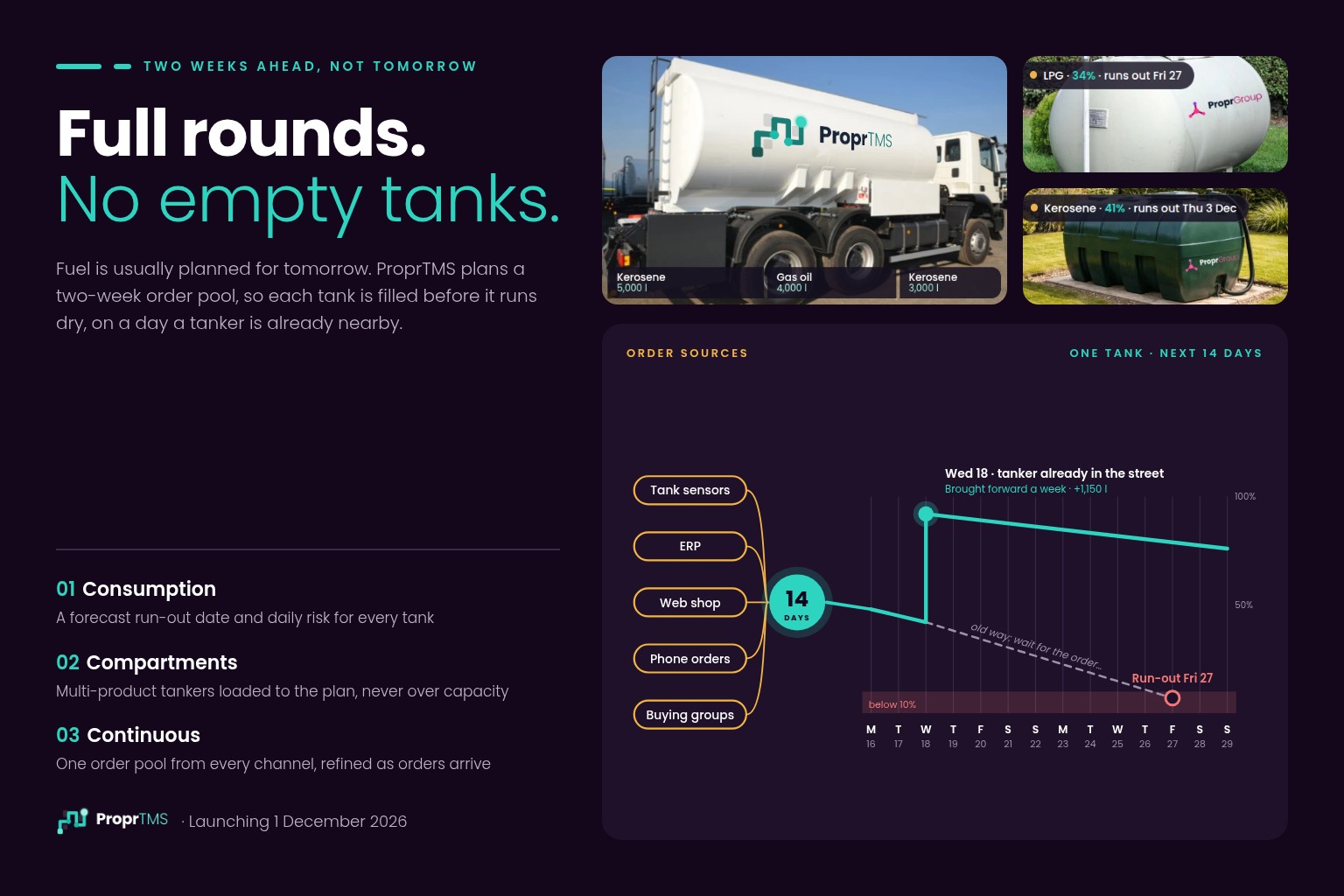
In short: Fuel distributors are judged on cost per litre delivered, and most of that cost is decided by how the rounds are built. Today, an order usually arrives one at a time and goes on tomorrow's route, so the day's geography is fixed before any optimisation runs. Tankers pass homes that will need fuel in five days, then drive the same road again next week. ProprTMS plans heating oil, LPG and gas oil from a two-week order pool instead: every tank has a consumption profile and a forecast run-out date, multi-compartment tankers are loaded to the plan, and continuous optimisation keeps refining the rounds as new orders arrive. Tanks get filled before they run dry, on days when a tanker is already nearby.
Who still depends on delivered fuel?
Over 1.5 million UK homes are off the gas grid. They, along with farms, hauliers, builders and industry, will rely on delivered kerosene, LPG and gas oil for years to come. The fastest carbon saving available isn't in the fuel. It's in how it is delivered.
Every one of those deliveries is a tanker visit to a tank, often down a rural lane, often miles from the next customer. Get the order of those visits right and you carry the same litres with fewer miles, fewer vehicle days and less diesel. Get it wrong and the cost shows up in every litre you sell.
Why is winter so hard on fuel distributors?
Because demand doesn't rise steadily. It arrives all at once.
A cold snap is forecast, every household checks its tank on the same evening, and the phones start ringing. Top-ups that could happily wait a week land in the same queue as customers who are about to run dry. Some of those customers are elderly or vulnerable, and running out isn't an inconvenience for them. It's a risk.
At the same time, everything that makes delivery harder gets worse. Days are short, lanes are icy, drivers are stretched and overtime climbs. Planners react to the loudest order rather than the most urgent tank, and emergency runs go out half full because there's no time to build a better round.
The customer who phones first isn't always the customer who'll run out first.
Why does planning one day at a time cost so much?
Because by the time the optimiser runs, most of the decisions have already been made.
In most fuel businesses an order arrives, from a tank sensor, an account, a website or a phone call, and is promised a delivery window. It goes onto the next available day. When the plan for that day is built, the geography is already fixed: the best software can only sequence the orders it has been given.
The result is familiar to anyone who has run a fuel round:
- Half-empty rounds. A tanker visits five customers in a village when another three nearby will need fuel within the week.
- Repeat miles. The same lane gets driven on Tuesday and again the following Monday.
- Emergency trips. A tank that nobody ordered for runs low, and a vehicle is sent specially.
- Product in the wrong place. Loads planned without checking which depot stocks which product, or which compartment can take it.
None of this is the planners' fault. It's what happens when a two-week problem is planned one day at a time.
What changes when you plan two weeks ahead?
The question changes. Instead of “how do we sequence tomorrow's orders?”, it becomes “what does this litre cost delivered today, with a tanker already in the street, against a dedicated trip next week?”
Answering that needs three things: a view of every tank that will need fuel over the next fortnight, a reliable idea of when each one will run out, and an optimiser that can move work between days without breaking promises already made. That's what we've built into ProprTMS.
How does ProprTMS plan fuel deliveries?
ProprPlan treats the next two weeks as one order pool and keeps refining the plan as the pool changes.
- One order pool, from every channel. Orders flow in from tank monitoring, your ERP, your web shop, phone orders taken by your team and collective buying schemes, through one integration API. Service plans add regular visits, at a set frequency or driven by consumption, automatically. When a plan or an order changes, the visits it generated are updated rather than duplicated.
- A consumption profile for every tank. Each tank has a forecast run-out date and a run-out risk for every day ahead. The real deadline is the run-out, not an arbitrary date on the order. And because a tank keeps emptying, a delivery made earlier takes fewer litres than one made later: the plan knows how much each tank will take on each day it could be visited.
- Earlier when it's cheaper. Continuous optimisation weighs the cost of a delivery on every day it could happen. When a tanker is already working the street, a top-up can be brought forward, so rounds stay geographically compact and drops per vehicle rise.
- Must-go first. Customers at risk of running out are planned before optional top-ups. The optimiser only fills spare capacity with discretionary work once the urgent tanks are covered.
- Compartments loaded to the plan. Multi-compartment tankers are packed as part of the optimisation, keeping products apart and every compartment within its capacity. Kerosene and gas oil travel together without a planner working out the split by hand.
- The right depot and the right vehicle. Loads are collected only from depots that stock the product, with reload trips planned where a round needs them. Vehicle rules keep the large tanker off the narrow farm track and the LPG bulk vehicle away from the cylinder depot.
- Nothing slips through. Jobs at risk of missing their run-out or delivery date are flagged on the plan and in the issues list. A single Schedule button shows which routes can take a job and the impact of each option on time, distance and capacity, and nothing is committed until the planner confirms.
How do customer timeslots fit in?
With ProprSlot, our timeslot booking add-on, customers ordering online choose a delivery slot that is checked against the routes you're actually running, not a static calendar. If a slot is offered, the round can genuinely deliver it.
That matters more for fuel than for most sectors. A customer who isn't about to run out can be offered a cheaper eco slot on a day a tanker is already passing. Demand gets shaped rather than simply absorbed, and the booking lands straight in the order pool for continuous optimisation to work around.
How does two-week planning compare with next-day planning?
| Next-day planning | Two-week order pool in ProprTMS | |
|---|---|---|
| Which day a tank is filled | The next available day after the order | The day that costs least, before the forecast run-out |
| Urgent tanks | Whoever phones first | Planned first, by run-out risk |
| Nearby customers who'll need fuel soon | Visited on a separate trip next week | Topped up while the tanker is in the street |
| Delivery volume | Fixed when the order is taken | Forecast for the day the tank is actually visited |
| Compartments | Split by hand | Packed in the optimisation, within capacity |
| Depot and product | Checked by the planner | Loaded only where the product is stocked |
| Orders from different channels | Re-keyed into the planning tool | One order pool through one API |
| Online bookings | A day or a window, confirmed later | Real slots from real routes, with eco options |
What is it worth?
Distributors are judged on cost per litre delivered, so the return comes from moving the same litres with fewer miles and fewer vehicle days.
More drops per vehicle means the same volume moves with fewer vehicle days, or more volume moves with the same fleet, which is growth without new tankers or drivers. Fewer emergency runs means less overtime in the weeks when overtime is hardest to find. And fewer miles is a real cut in your own emissions, not an offset.
As an illustration only: a 60-vehicle fleet driving 32,000 miles per vehicle a year at 8 miles per gallon burns about 1.09 million litres of diesel. Cut 10% of those miles and you save about 109,000 litres and roughly 280 tonnes of CO2e a year. Your customers on farms, sites and in haulage get lower-carbon deliveries to report against, too.
We won't promise you a percentage before we've seen your operation. What we will do is help you measure it against your own baseline.
“Fuel is one of the clearest cases I've seen of a problem being planned on the wrong horizon. The data to look two weeks ahead already exists in most distributors. What's been missing is a planning engine built to use it. That's what we've set out to change, Propr'ly.”
Who is this for?
ProprTMS fuel planning is aimed at UK distributors of heating oil, LPG, gas oil and lubricants who:
- deliver to domestic, farm, commercial or industrial tanks, or a mix
- take orders from several channels, such as tank monitoring, an ERP, a web shop, phone and buying groups
- run multi-compartment tankers or carry more than one product
- plan tomorrow's rounds from today's orders and suspect they're driving the same lanes twice
- want to protect vulnerable customers from running out over the winter
It's the same platform you'd use for any other routing work, so cylinder rounds, bulk deliveries and lubricants can all be planned on the same screens.
Frequently asked questions
What is a consumption profile?
A consumption profile describes how quickly a tank is expected to empty. ProprTMS uses it to forecast a run-out date and a daily run-out risk for each tank, and to work out how much the tank will take on each day it could be delivered to.
Why plan fuel deliveries two weeks ahead?
Because most tanks don't need filling on one specific day. Looking two weeks ahead lets the optimiser fill a tank on a day a tanker is already nearby, rather than sending a dedicated trip later, while still delivering before the run-out.
Does ProprTMS handle multi-compartment tankers?
Yes. Compartments are packed as part of the optimisation, keeping products apart and every compartment within its capacity.
Can orders come from several systems at once?
Yes. Orders from tank monitoring, ERP systems, web shops, phone orders and buying groups all flow into one order pool through our integration API.
What happens to customers at risk of running out?
They are planned before optional top-ups. Any that can't be placed are flagged on the plan, and the planner can see which routes could take them and the impact of each option before committing.
Can customers book their own delivery slots?
Yes, with ProprSlot. Customers choose from slots checked against your live routes, and you can offer cheaper eco slots where a tanker is already passing.
Ready to prove it?
Don't take our word for it. With Propr Start, you run ProprTMS in your live operation for three months and measure it against your own baseline, through the winter if you like, before you decide.
We launch on 1 December 2026 and founding customer places are open now. If you deliver heating oil, LPG or gas oil in the UK, we'd love to hear how you plan for winter.
Sources and assumptions
The worked example in this article is illustrative, not customer data. It assumes 60 vehicles, 32,000 miles per vehicle a year and 8 miles per imperial gallon (4.546 litres), giving about 1.09 million litres of diesel a year; a 10% cut in miles saves about 109,000 litres. The CO2e figure uses the UK Government's 2026 average-blend diesel factor of 2.54016 kg CO2e per litre. Dates, tank levels and compartment volumes in the image are illustrative.