
Why do high and low density routing still need separate software?
James Holt · Co-founder
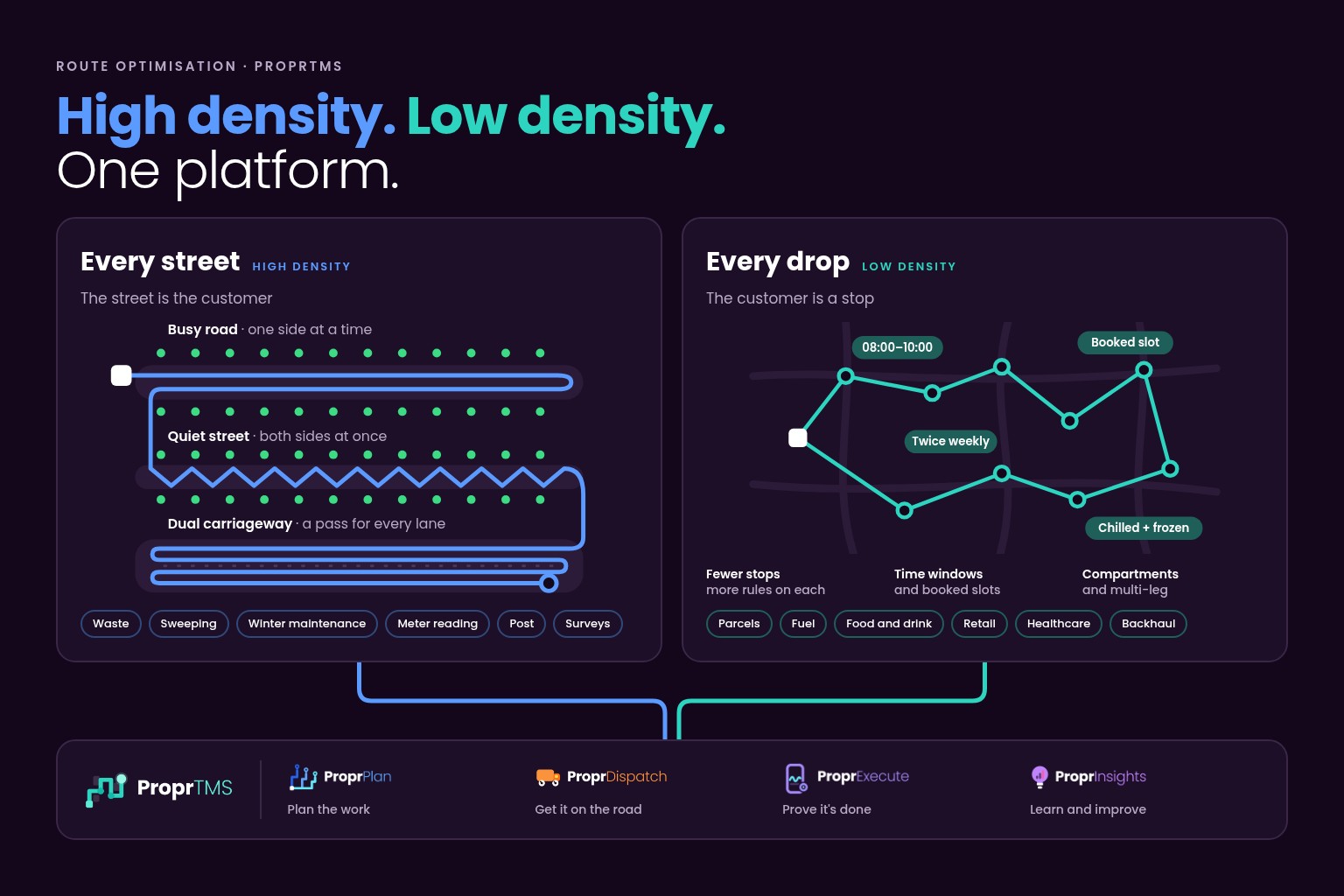
In short: Route optimisation splits into two kinds of work. In high density routing the street is the customer, so every street has to be driven, once, in the right order. In low density routing the customer is a stop, and there are fewer stops but more rules on each. The industry has always sold separate products for each, often with a third for sector rules, and operators pay for that in licences, implementations, retraining and split data. ProprTMS handles both on one platform, with the same engine and the same screens.
What's the difference between high and low density routing?
The difference is whether you're servicing the street itself or the stops along it.
Both depend on an accurate road network. One-way streets, turn restrictions and vehicle limits for height, weight, width and length apply to every route, whatever the work. A plan that sends a lorry the wrong way down a one-way street or under a low bridge is no use to anyone. Where the two differ is in how they use that network. In the industry they're known as arc routing (for streets) and vehicle routing (for stops).
What is high density routing?
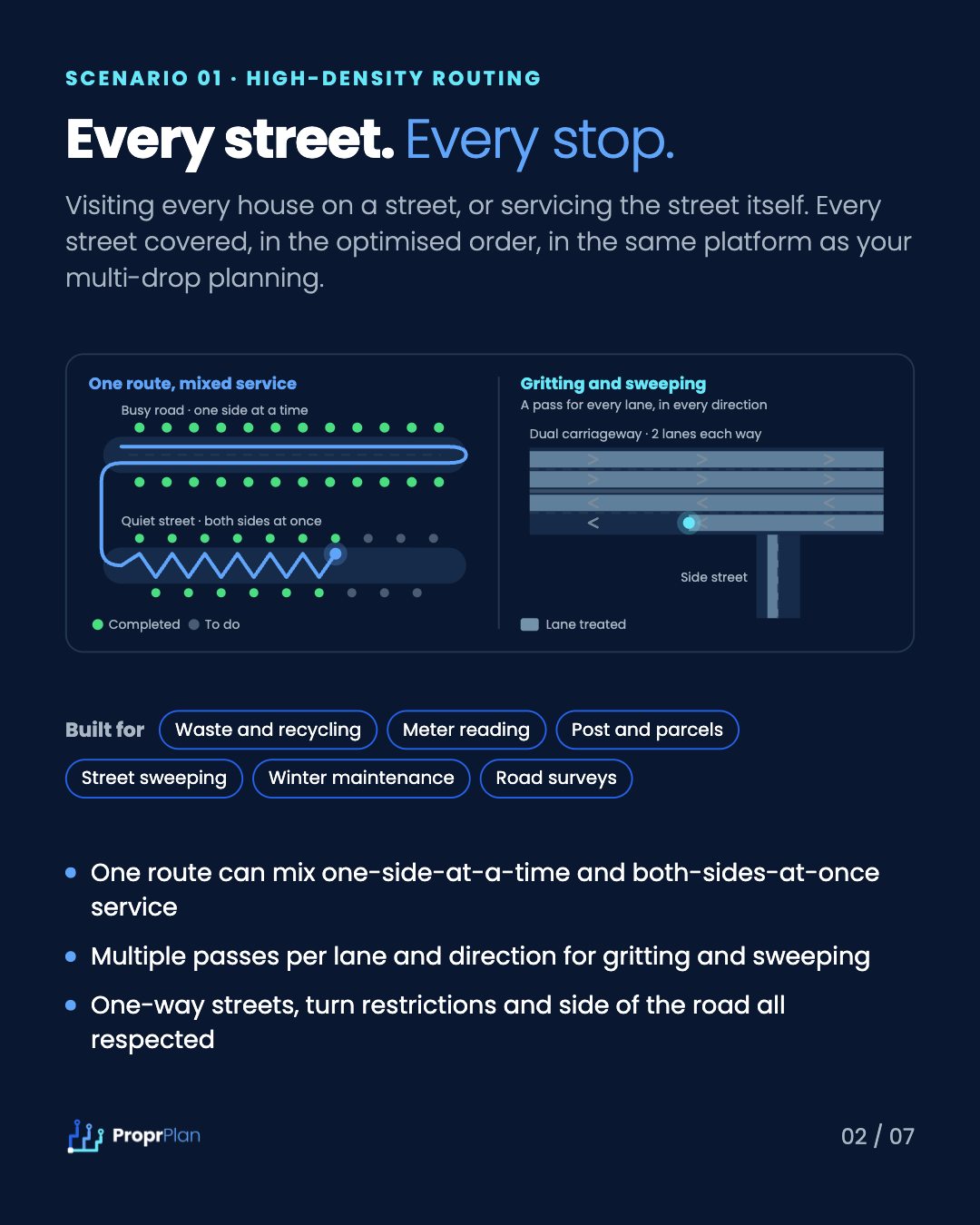
High density routing is planning work where the street is the customer. The vehicle can't just visit the street. It has to drive down it to do the job. That's true when the work is visiting every house along a street (waste, recycling and garden waste collection, meter reading, post and parcel delivery), and when it's servicing the street itself (street sweeping, winter maintenance, and surveying road networks and street assets).
So the plan isn't a list of stops. It's the order in which every street gets driven, once, with as little driving as possible on roads that are already done or don't need doing.
Each street also needs the right pattern of work:
- A single pass down the middle.
- Several passes on a wide road, such as one for every lane when gritting.
- Both sides at once, zig-zagging across a quiet street.
- One side at a time on a busy road, coming back later for the other side.
Because the vehicle is working in the traffic lane, the road network decides the order of the work, not just the way between jobs. A no-U-turn rule or a low bridge can mean driving round several blocks just to come back and do the other side of the same street.
What is low density routing?
Low density routing is planning work where the customer is a stop: a specific address such as a shop, a house or a site. The roads are how the vehicle gets between stops. The plan finds the fastest or shortest legal route from one to the next, and the work happens when the vehicle arrives.
There are fewer stops, but each one carries more rules. Those rules include:
- time windows
- vehicle compartments
- timeslots booked at checkout
- multi-frequency visits
- multi-leg distribution
- on-vehicle stock
- contamination rules
It covers parcel and grocery delivery, fuel, LPG and lubricants, food and drink distribution, retail replenishment, healthcare and field service, merchandising, backhaul and trunking.
The hard part is no longer covering every street. It's fitting a long list of competing rules into a plan that still works when the vehicles leave the yard.
Parcel delivery appears in both lists on purpose. A round that covers every house on every street and a rural route full of booked timeslots are both parcel delivery, and they're very different routing problems. Plenty of operations live on both sides of the line.
Why are they sold as separate products?
The industry treats high and low density routing as two separate worlds. You buy one specialist application for high density work and another for low density, and often a third for the rules of your particular sector.
James Holt, co-founder of ProprGroup, has spent 20 years in route optimisation software: ten on high density routing, then ten on low density.
“Through all of it, one thing has frustrated me more than anything else. I have sat with plenty of operators running two or three routing products side by side, and none of them chose that because it was the best way to work.”
What does running two or three routing systems cost?
It costs more than the licence fees. Customers pay for split routing in four ways:
- Multiple licences and multiple implementations. Each product brings its own contract, its own project and its own go-live.
- Specialist training, then retraining every time someone changes role. Moving a planner from one operation to another means starting again.
- Planners who know one tool but are lost in the other. That isn't the planners' fault. They've been handed two tools that work in different ways.
- Plans and data split across systems that don't talk to each other. Seeing the whole operation in one place means stitching it together by hand.
Nobody designs an operation around three routing systems. They end up there.
How does ProprTMS handle both?
ProprTMS is a single SaaS platform that handles both high density and low density routing.
- One engine for every street and every drop. Same engine, same screens.
- The road network built in. One-way streets, turn restrictions and vehicle height, weight, width and length limits are respected on every route, whatever the work.
- The right pattern for every street. Single pass, a pass per lane, both sides at once, or one side at a time, set street by street in ProprPlan.
- The same familiar interface whatever the sector, role or density of work. Intuitive screens and a short learning curve.
- Every planning horizon in one tool. Strategic, master route and territory planning sit alongside daily optimisation in ProprPlan.
- Pay once. One subscription, with no second licence or implementation, and training that stays with your people when they change roles.
It also follows every job end to end, from the first plan to the final report:
- ProprPlan: plan the work. Automatic optimisation across the whole fleet, with vehicle, driver and time-window constraints, drag-and-drop changes, and plans from imported orders or manual entry.
- ProprDispatch: get it on the road. Routes sent straight to drivers' devices, a live view of every vehicle against plan, and re-planning on the day.
- ProprExecute: prove it's done. A driver app capturing signatures, photos, delivery notes and failed-delivery reasons, synced to the office.
- ProprInsights: learn and improve. Dashboards for on-time performance, cost per drop and fleet use, plain-English questions answered from your data, and exceptions flagged automatically.
| Separate routing products | ProprTMS | |
|---|---|---|
| High and low density work | A different product for each | One engine for both |
| Sector rules | Often a third, specialist product | In the same platform |
| Licences and implementations | One per product | One subscription, one implementation |
| Planner moves role | Retrain on a new tool | Same screens, nothing to relearn |
| Plans and data | Split across systems | In one place |
“This is one of the clearest ways we're trying to do things differently and challenge a status quo that has lasted far too long. Or, as we like to put it, Propr'ly.”
Who is this for?
ProprTMS is built for UK operators who:
- run street-by-street rounds, scheduled deliveries, or both
- use two or three routing products side by side today
- move planners between operations and retrain them each time
- want one view of their plans and data instead of several
Frequently asked questions
What is the difference between high density and low density routing?
High density routing is for work where the street itself is the customer, so the vehicle has to drive every street to service it, as in waste collection, street sweeping or gritting. Low density routing is for work where the customer is a stop, such as a shop or a house, and the roads are just the way between stops. Low density stops are fewer but carry more rules, such as time windows and booked timeslots.
What are arc routing and vehicle routing?
They're the technical names for the two. Arc routing plans the order in which streets are driven and serviced (high density). Vehicle routing plans the order of visits to individual stops (low density).
Can one routing engine really handle both?
Yes. In ProprTMS the same engine plans street coverage, including the pattern of work on each street, and rule-heavy delivery work, with time windows, compartments and multi-leg distribution.
Do planners need different training for each type of work?
No. The interface is the same whatever the sector, role or density of work, so training stays with your people when they change roles.
Do I need a separate licence for high density routing?
No. Both run on the same platform under one subscription, with no second licence or implementation.
Does ProprTMS handle gritting and street sweeping?
Yes. Winter maintenance and street sweeping are planned as high density work, with a pass for every lane in every direction and road restrictions respected.
Ready to prove it?
Most transport software asks you to commit for years before you've seen a single result. We think that's the wrong way round. There's no 36-month lock-in and no heavy implementation fee. With Propr Start, you run ProprTMS in your live operation for three months and measure it against your own baseline before you decide.
We launch on 1 December 2026 and founding customer places are open now.